Most buyers assume a high nit count solves the outdoor visibility problem. They spec a 3000-nit panel, bolt it to a concrete pad, and wait for the sun to come out. By noon, the screen is unreadable.
Raw brightness is only one variable in a complex optical equation. When direct sunlight hits a digital signage display, two distinct physical reactions occur. First, ambient light bounces off the outer protective glass, creating a mirror effect that washes out the contrast ratio. Second, the sun's infrared energy bakes the LCD panel trapped behind that glass.
Sunlight readability requires three systems working together: high-luminance backlighting, precise optical treatments to kill surface glare, and aggressive thermal management to keep the liquid crystals from boiling. Miss one of these elements, and the display will fail on site. A naked 3500-nit panel placed in a parking lot will turn black from solar clearing—known as the isotropic state—in under an hour.
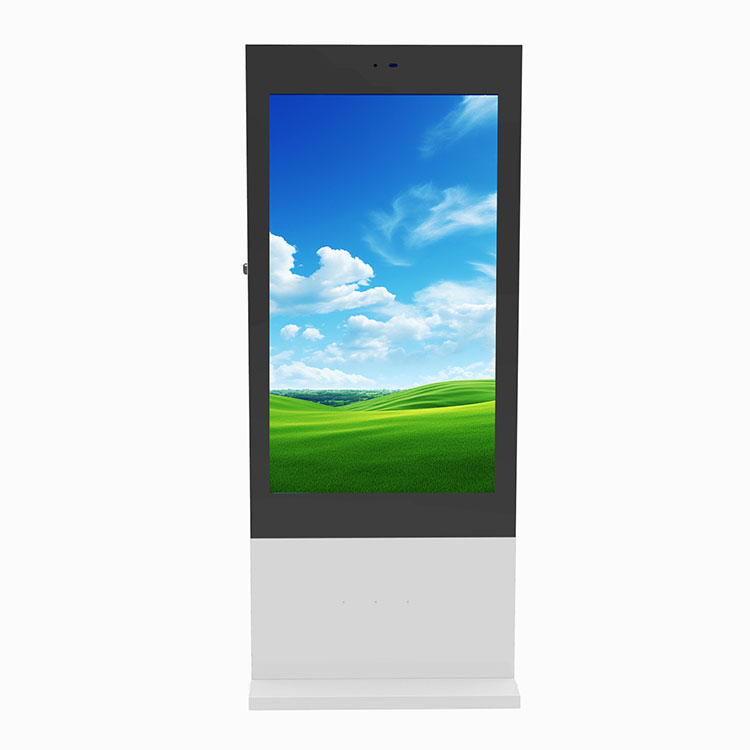
B2B buyers sourcing commercial hardware for retail, education, or transportation sectors cannot afford downtime. A screen that only works on cloudy days is useless. To guarantee performance, manufacturers engineer specific hardware layers into the display stack.
Standard tempered glass reflects roughly 8% of the light that hits it. Outdoors, that creates a perfect mirror. Shoppers end up looking at their own reflection instead of the menu board or wayfinding map.
To fix this, high-end outdoor displays use Anti-Reflective (AR) glass. Do not confuse this with Anti-Glare (AG) treatments. AG glass works by etching the surface to scatter light, which makes reflections fuzzy but heavily degrades the sharpness of a 4K HD resolution display. AR glass uses microscopic optical coatings to disrupt reflected light waves entirely, dropping the surface reflection rate below 2%. When you pair AR glass with a high-contrast panel, the image survives the glare.
Then there is the issue of blinding people at night. A freestanding outdoor LCD player running at 3000 nits after dark looks like a security floodlight. It wastes electricity, washes out the actual content, and creates a driving hazard near roadways. Ambient light sensors actively monitor the surrounding environment. As dusk falls, the sensor commands the logic board to step the brightness down to a comfortable 300 to 500 nits. When the morning sun hits the glass, the panel ramps back up to maximum output automatically.
Heat destroys liquid crystal displays. An LCD panel operates by twisting liquid crystals to block or pass light from the LED array behind it. If the internal temperature pushes past 100°C—a very real threat when a black screen faces direct afternoon sun—the crystals lose their structure. The screen develops massive black blotches that look like spilled ink. This isotropic failure is the most common killer of poorly specified outdoor digital signage.
To prevent this, the enclosure must act as both a heat sink and an environmental shield. Shenzhen-based manufacturer Cuhub builds their enclosures from galvanized steel. This material resists corrosion in wet environments while providing a rigid structural frame that will not warp under extreme thermal stress.
Inside these galvanized steel bodies, active cooling systems take over. High-velocity fans or closed-loop air conditioners cycle the internal air. They pull the heat away from the backlight array and the rear of the LCD panel, exhausting it through baffled vents that maintain the unit's weatherproof IP rating.
Every hardware choice carries a physical trade-off. High-brightness screens consume significant power. Pushing a large-format display to 3500 nits requires a massive LED backlight array, which draws heavy current. Installers must plan their electrical infrastructure accordingly, often requiring dedicated circuits for multi-screen kiosk deployments.
Viewing angles present another boundary. Premium panels offer a 178-degree viewing angle, keeping colors accurate when seen from the side. But in harsh daylight, extreme off-axis viewing still suffers from perceived contrast loss. The sheer volume of ambient light competing with the screen means readability naturally degrades the further you step away from dead center.
Polarized sunglasses create a specific field issue. LCDs rely on polarizing filters to function. If a viewer wears polarized sunglasses, and the screen's polarization angle aligns with the glasses, the display will look completely black. Engineering around this requires specific retardation films applied to the glass, an added cost that buyers often overlook until customers complain.
Maintenance is a reality you must budget for. While galvanized enclosures keep rain out, air filters on fan-cooled units require periodic replacement. If a filter clogs with urban street dust or spring pollen, the internal temperature spikes and the cooling system fails. Sourcing commercial outdoor display screens means committing to a physical maintenance schedule.
Procuring the hardware is only half the job. Managing a fleet of fifty outdoor screens across a transit network breaks traditional IT workflows. You cannot send technicians with USB drives to update video files in the rain.
Modern digital signage relies on **cloud intelligent backend management**. Operators push 4K HD video, localized images, and interactive web apps to specific terminals instantly through secure web portals. This software does more than change pictures. It monitors the hardware health in real-time. If an enclosure fan fails or the internal temperature creeps dangerously close to the isotropic threshold, the backend system alerts the operator and can automatically dim the backlight to save the panel.
AI-driven scheduling allows these platforms to trigger content based on real-world conditions. A drive-thru menu board can swap out hot coffee promotions for iced drinks when the local temperature crosses 80 degrees. If you source an outdoor multi-function LCD player equipped with a camera and touch technology, the software can track basic engagement metrics, tallying how many users interacted with a wayfinding map during rush hour.
What is the minimum nit rating for direct sunlight?
Direct, unshaded sunlight requires at least 2500 to 3500 nits. If the screen lives under a deep architectural awning or inside a covered transit shelter, 1000 to 1500 nits is usually sufficient.
Can I put an indoor screen in a waterproof box?
No. Indoor screens lack the necessary brightness—usually topping out at 500 nits—and will overheat rapidly inside a sealed box. The panel will suffer isotropic failure within hours of direct sun exposure.
How do manufacturers ship these units for large deployments?
B2B suppliers like Cuhub offer OEM, ODM, SKD (Semi Knocked Down), and CKD (Completely Knocked Down) manufacturing. If you have local assembly capabilities, routing panels and galvanized enclosures as SKD or CKD components can drastically reduce import duties and freight costs.
Do outdoor touch screens actually work in the rain?
Yes, if specified correctly. Projected capacitive (PCAP) touch sensors used in smart touch models can be tuned via firmware to ignore water droplets while accurately registering a bare or gloved finger.
Sunlight readability comes down to optical contrast and thermal survival. You need enough backlighting to outshine the sun, AR glass to stop glare, and a galvanized steel enclosure to manage the heat. Specify those three elements correctly, and your outdoor display will actually be legible when your customers walk up to it.